

Written and edited by: Jackson Bandy (knb003@marietta.edu)
With Election Day for the 2026 midterms less than one week away, it is important that prospective voters know who — and what — they are voting for. This is especially true this year, with Ohioans weighing in on six key races. Perhaps the most contested race is for Ohio Governor, with three main candidates still in the running.
Candidate Profiles: Policies and Promises

Representing the Republican Party is Vivek Ramaswamy, with Ohio Senate President Rob McColley as his running mate. A native to Cincinnati, Ohio, Ramaswamy has a background in entrepreneurship, founding the pharmaceutical company Roivant Sciences in 2014. He self-advertises as “running on a conservative, business-grounded agenda,” and his campaign promises more money in his potential constituents’ pockets. To deliver this, he intends to slash property taxes, reduce energy costs, phase out Ohio’s state income tax and reduce “government bloat” as stated on his campaign’s website.
In addition, Ramaswamy insists on raising state academic standards: focusing on literacy, numeracy, and civics benchmarks; paying teachers more by drawing in top talent into the profession; and expanding career-technical education for Ohio students to create pathways to real-world jobs. Ramaswamy also supports a tougher stance on crime to “restore law and order in our cities”, stating that he will back the blue and enforce stricter bail and sentencing requirements for repeat offenders.
The Democratic Party candidate is Dr. Amy Action, with former chair of the Ohio Democrats David Pepper as her running mate. Acton was raised in Youngstown, Ohio and makes no secret of her difficult childhood. This upbringing shaped her worldview and led her to medical school — and later, her role as director of the Ohio Department of Health. Now, she is running for governor on a similarly caring agenda, promising to secure tax cuts for families, end governmental corruption and lower costs of health care.
Acton’s campaign also recognizes the importance of education, aiming to restore public school funding and guaranteeing free breakfast and lunch for all students. She also intends to protect reproductive freedoms, push for anti-discrimination laws for LGBTQ+ and Black Ohioans, and support veterans and rural communities by bolstering their respective infrastructures to ensure their health.

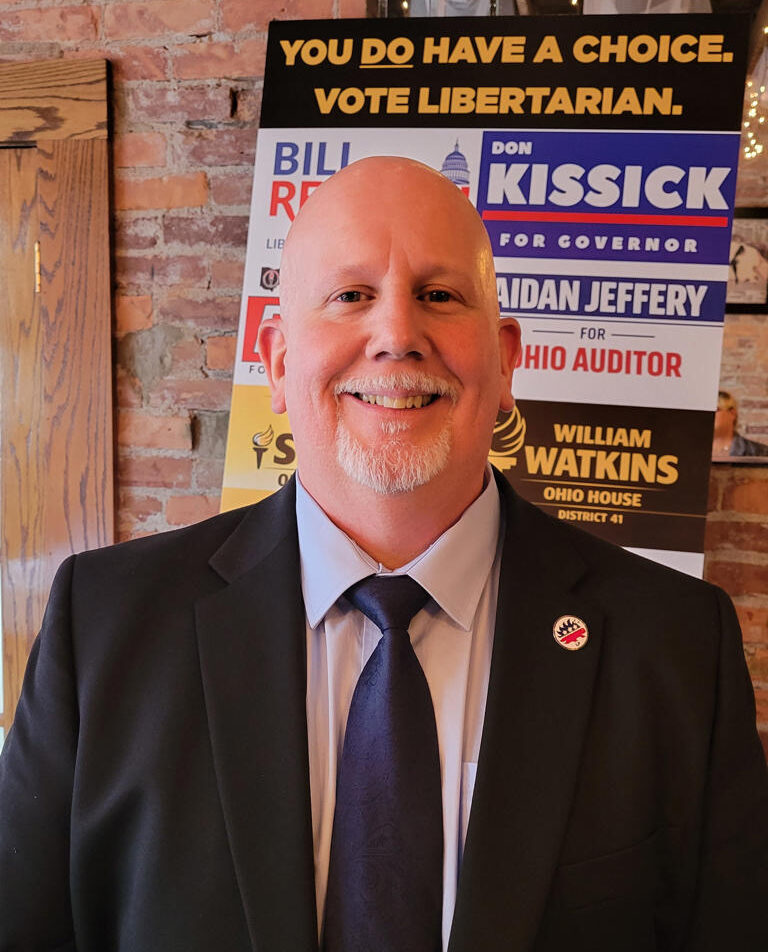
Finally, Don Kissick, with James Mills as his running mate, represents the Libertarian Party. Kissick served in the U.S. Navy for six years and moved to Ohio with his late wife Marcy in 2007, now residing permanently in the northwestern part of the state. As implied by his political affiliation, Kissick’s campaign promises to protect individual liberties — he intends to secure property tax cuts, promote small businesses and end unnecessary governmental oversight.
Unlike his opponents, Kissick takes a stance on Flock cameras, stating that he would restrict or prohibit their use entirely in Ohio to make sure that Ohioans are “treated like free people, not suspects whose daily movements belong in a government-accessible database.” He also supports legal recognition of LGBTQ+ marriages in Ohio, the deregulation of the marijuana industry and barring legislators from becoming lobbyists for 5 years after they leave office to prevent corruption. His campaign also opposes ICE, mentioning that immigration enforcement should be civil, not militarized — and that the process to obtain citizenship should be straightforward, with violations dealt with “like any other criminal infraction.”
Data Centers: Who Says What?
The issue of data centers has become important for a growing number of voters across the U.S. Under the current system, there is little regulation regarding data center construction, leading to air, noise and water pollution in small towns. Nearly one quarter of Ohioans live in rural areas, according to data from 2023, making the issue even more prevalent for the state’s voters.
Ramaswamy states that while he will not prevent data centers from being built, he will ensure Ohioans will be protected under state legislature — those living near data centers will not pay for electricity, will have lower property taxes, and will continue to have air and water that meet current quality standards.
Acton describes her stance on data centers as a “conditional moratorium.” She proposes that all data centers must have their costs covered by their investors, must be built exclusively through union labor and must reside on brownfields, not in the heart of rural communities. In addition, she touts that data centers must have strict regulations to maintain zero environmental impact — protecting clean air and water for all Ohioans.
Kissick, tying into his opinions on Flock cameras, thinks of data centers as part of a “growing surveillance infrastructure.” He recognizes both their environmental impacts, as well as the way that their construction often benefits corporations rather than the common person. As a result, Kissick also calls for regulations on data center construction before they are built, for all costs to be covered by their investors, and transparency in all aspects of the project’s completion.
Voting: Where and When?
Ohio’s early voting process is nearly over — all in-person early votes must be cast by Sunday, Nov. 1 at 5 p.m. Voters wishing to cast their ballots on Election Day (Nov. 3) may do so between 6:30 a.m. and 7:30 p.m. at their designated polling place. For more information regarding the voting process, visit ohiosos.gov/elections.
References
Dr. Amy Acton for Governor. (n.d.). Dr. Amy Acton for Governor. https://actonforgovernor.com/
Explore Rural Population in Ohio | AHR. (n.d.). americashealthrankings.org. https://www.americashealthrankings.org/explore/measures/pct_rural_b/OH
Kissick/Mills for Ohio. (n.d.). Kissick/Mills for Ohio. https://donkissick.com/
Trau, M. (2026, August 10). All candidates for ohio governor have now called for restrictions on data center boom. ohiocapitaljournal.com. https://ohiocapitaljournal.com/2026/08/10/all-candidates-for-ohio-governor-have-now-called-for-restrictions-on-data-center-boom/
Vivek for Ohio. (2024, December 16). Vivek for Ohio. https://vivekforohio.com/


